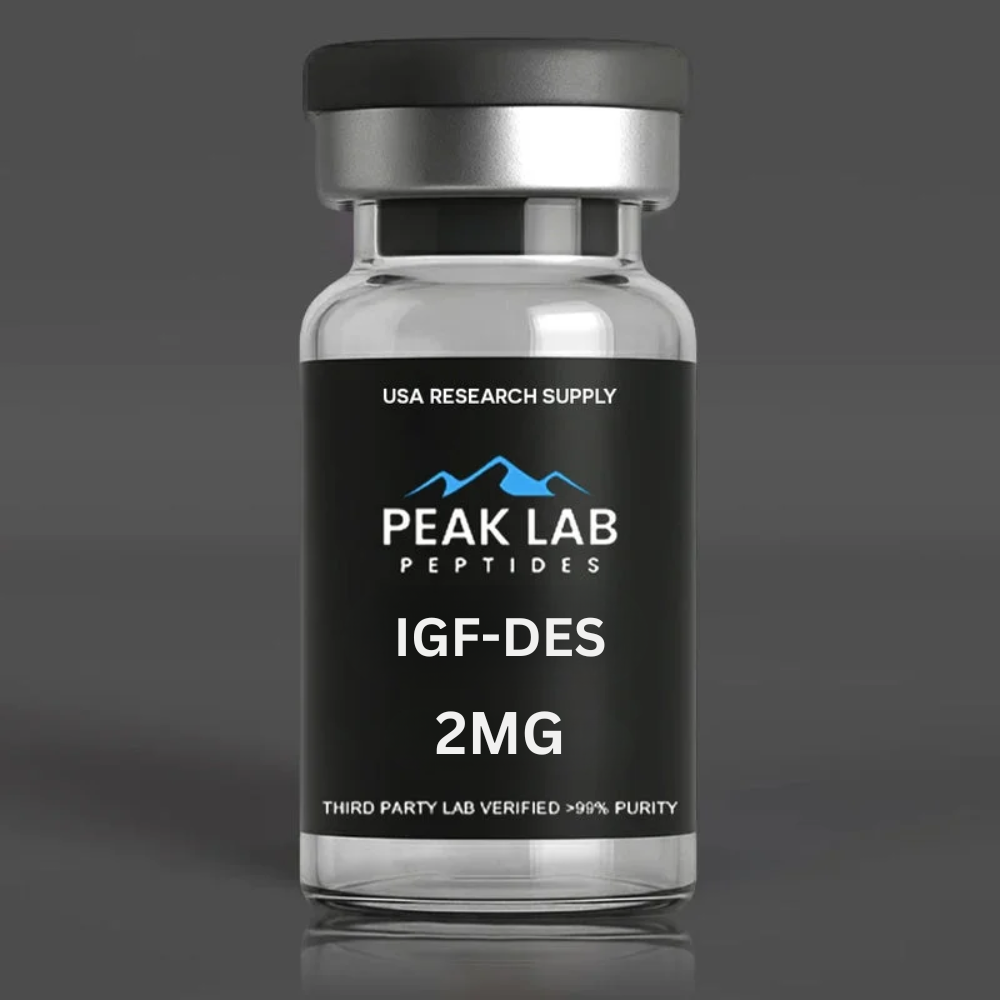

IGF-DES 2 mg

Original price was: $54.00.Current price is: $43.20.

Member Price: $34.56 Become a member →
...
99%+ purity guaranteed
USA Lab Verified

Become a Member and save 20% on Every Order. 

Become a Member

EMAIL US FOR WHOLESALE PRICING
Orders of $5,000 or more

Description

Description

IGF-DES (Des(1-3)IGF-I) is a synthetic peptide analog of Insulin-like Growth Factor-1 (IGF-1) designed to enhance anabolic signaling in muscle and tissue repair studies. This truncated form lacks the first three N-terminal amino acids, giving it reduced binding to IGF-binding proteins (IGFBPs) and dramatically increasing its local biological activity in research settings.

Due to its high potency and rapid onset, IGF-DES is often studied in short-duration experimental cycles (4–6 weeks), particularly in localized models of muscle hypertrophy, repair, and regeneration. It is commonly supplied as a white, lyophilized powder and requires proper storage and reconstitution for in-vitro or in-vivo use in animal models.


Overview
  • Peptide Type: Des(1-3) Insulin-like Growth Factor-1
  • Sequence: Truncated at N-terminus (removal of first 3 amino acids)
  • Activity: Strong, localized anabolic effects; rapid clearance
  • Molecular Weight: ~7.65 kDa
  • Form: Lyophilized powder
  • Storage:
    • Long-term: –20°C
    • Short-term: 0–4°C
  • Research Use:
    • Muscle growth and hypertrophy models
    • Tissue repair and recovery signaling
    • Anabolic pathway stimulation

Note: For research use only. Not for human or clinical application.

Research

1. Muscle Hypertrophy & Protein Synthesis

IGF-DES is commonly used in studies focused on skeletal muscle growth and localized hypertrophy, due to its enhanced activity in muscle tissue. It stimulates myoblast proliferation, satellite cell activation, and mTOR signaling pathways, contributing to muscle fiber development in preclinical models.

2. Tissue Regeneration & Injury Recovery

This peptide analog plays a key role in wound healing, ligament repair, and post-injury muscle recovery studies. Researchers investigate IGF-DES’s ability to enhance fibroblast proliferation, collagen expression, and structural tissue reformation.

3. Reduced IGFBP Affinity = Enhanced Bioactivity

By lacking the first three amino acids of IGF-1, IGF-DES exhibits lower affinity to insulin-like growth factor binding proteins, allowing more free peptide to interact with IGF-1 receptors in localized tissues.

4. Pharmacokinetics & Delivery Optimization

Studies frequently examine administration routes (e.g., localized intramuscular injection) and timing protocols to optimize retention, distribution, and receptor activation within target tissues in animal models.

FAQ 

Q: What makes IGF-DES different from IGF-1?
A: IGF-DES is a shortened form of IGF-1, missing the first three amino acids. This change reduces its binding to IGF-binding proteins (IGFBPs) and increases its bioavailability and potency, particularly in localized tissues.

Q: What is IGF-DES used for in research?
A: It's primarily used to investigate muscle repair, hypertrophy, and tissue regeneration due to its strong anabolic effects and fast-acting properties in localized applications.

Q: Can IGF-DES be used systemically?
A: While possible in models, IGF-DES is typically used locally in research to minimize systemic degradation and focus on targeted anabolic effects.

Q: Is IGF-DES suitable for long-term studies?
A: Most experimental protocols use IGF-DES in short cycles (4–6 weeks) due to its rapid activity and clearance characteristics.

Q: Is IGF-DES approved for clinical use?
A: No. IGF-DES is strictly for in-vitro or in-vivo preclinical research. It is not approved for human or therapeutic use.

Shipping & Delivery

Storage & Handling

All peptides are supplied as sterile, lyophilized powder and are stable when handled correctly.

  • On arrival: Store vials in a cool, dry place away from heat and direct sunlight.
  • Long-term (powder): For optimal longevity, keep lyophilized peptides refrigerated to help maintain integrity.
  • After reconstitution: Use an appropriate research diluent (for example, BAC water). Store the reconstituted solution in the refrigerator and use within 20–30 days for best stability.

Note: Minimize exposure to moisture and repeated freeze–thaw cycles. Follow your institution's safety procedures when handling research materials.

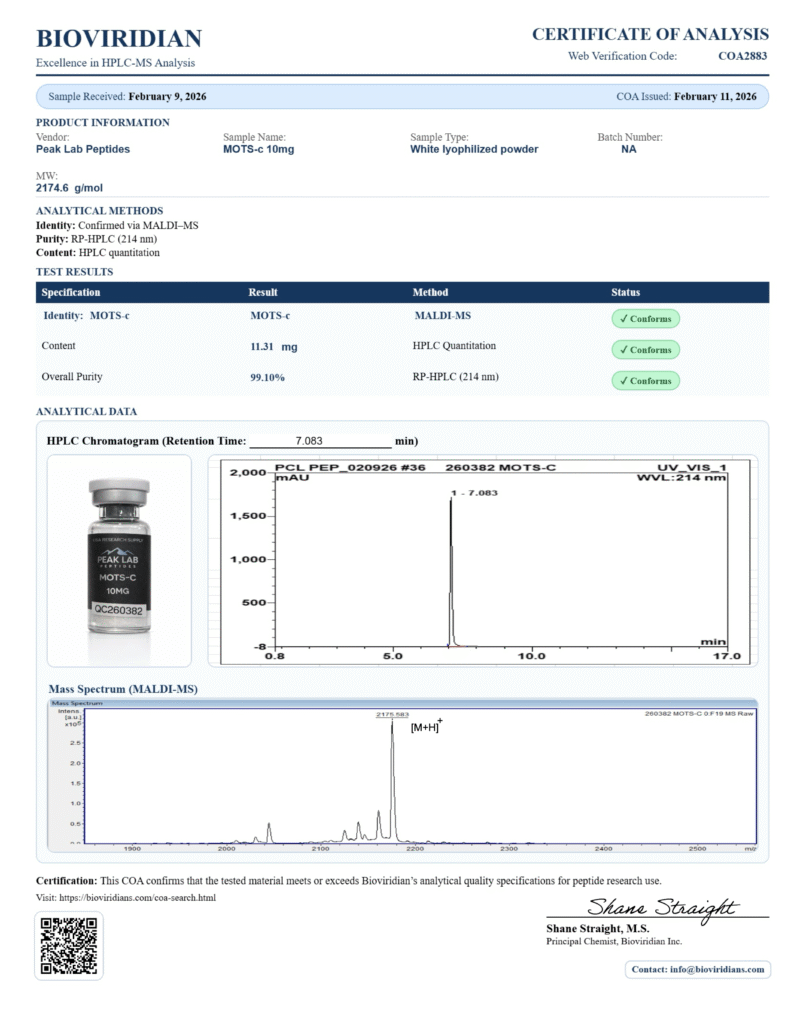
Peak Lab Peptides maintains quality-control processes and routinely performs third-party testing to support purity and identity verification. COAs are available upon request for applicable batches. Documentation may vary depending on production timelines.

We aim to make batch-level documentation available whenever possible. Our goal is to expand COA access across the full catalog as production capacity grows.

All products are for laboratory research use only and are not intended for human consumption.