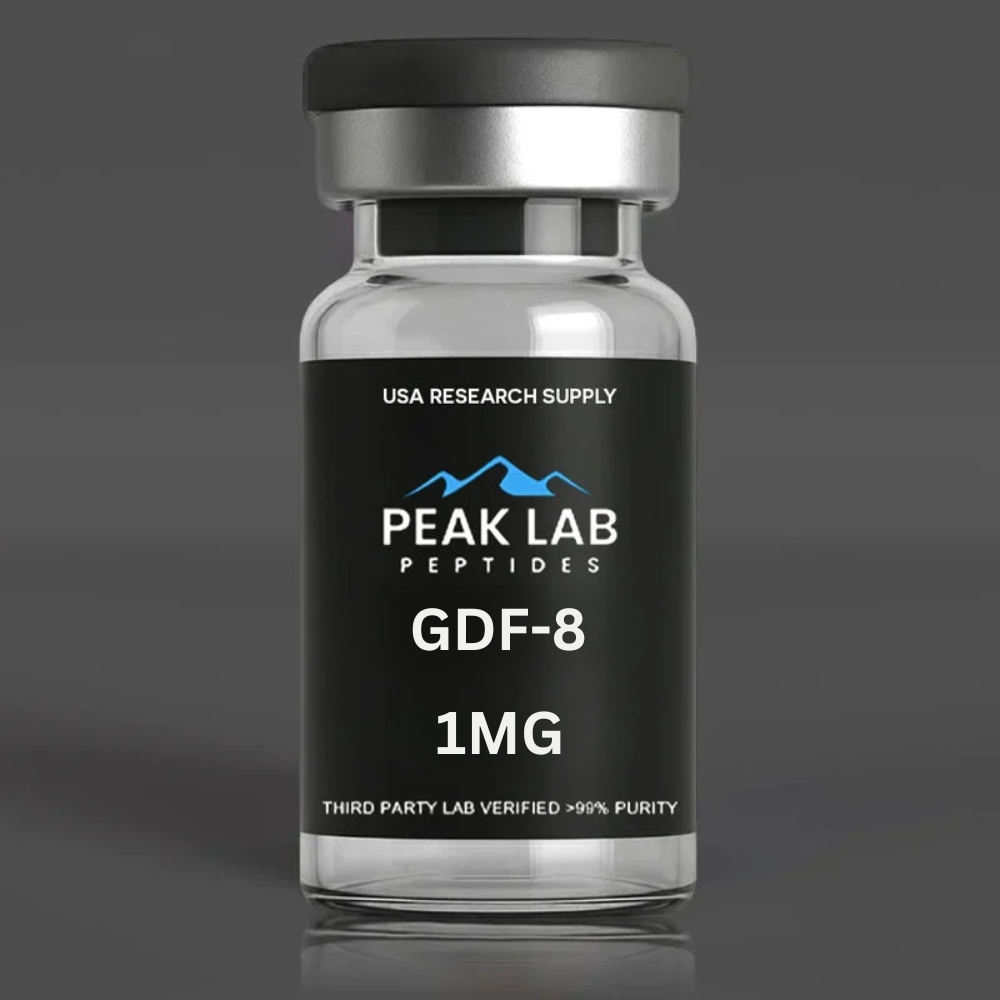
GDF-8

Member Price: $116.80 Become a member →
...
99%+ purity guaranteed
USA Lab Verified

Become a Member and save 20% on Every Order. 

Become a Member

EMAIL US FOR WHOLESALE PRICING
Orders of $5,000 or more

Description

Description

GDF-8, also known as myostatin, is a member of the transforming growth factor-beta (TGF-β) superfamily and is widely studied as a key negative regulator of skeletal muscle growth in mammals. In research settings, recombinant or synthetic GDF-8 is used as a reference protein or target molecule in studies of muscle development, tissue remodeling, and TGF-β–related signaling networks.

This GDF-8 product is designated strictly as a research chemical for in vitro testing and laboratory experimentation. It is not a drug, food, or cosmetic, and is not intended for human or veterinary use, consumption, or application of any kind. Handling is restricted to licensed, qualified professionals in appropriate research environments.

Overview

GDF-8 (Growth Differentiation Factor 8) is a secreted protein primarily expressed in skeletal muscle, where it plays a central role in limiting muscle growth and differentiation. By binding to activin type II receptors and activating downstream SMAD signaling pathways, GDF-8 acts as a checkpoint in myogenesis and muscle mass regulation in preclinical models.

In laboratory research, GDF-8 is commonly used to:

  • Serve as a ligand for receptor-binding and signal-transduction assays
  • Provide a defined target for neutralizing agents such as antibodies, follistatin, or engineered peptide inhibitors
  • Model TGF-β superfamily signaling in muscle, metabolic, and developmental biology
  • Support assay development, including ELISA, Western blot, and cell-based bioactivity tests

All experimental use must be confined to in vitro or ex vivo systems, or other non-clinical research frameworks that comply with applicable regulations.

Research

GDF-8 in Muscle Biology and Myogenesis

GDF-8 (myostatin) is best known for its role in restricting skeletal muscle growth in animal models:

  • Genetic loss-of-function or reduced GDF-8 activity has been associated with increased muscle mass in multiple species, making GDF-8 a central focus of muscle-growth regulation studies.
  • In vitro, GDF-8 exposure is often used to investigate pathways that inhibit myoblast proliferation and differentiation. Researchers measure changes in myogenic markers, cell morphology, and fusion to clarify how GDF-8 shapes myogenesis.
  • GDF-8 also serves as a reference ligand in experiments testing potential myostatin-neutralizing molecules, such as certain binding proteins or engineered peptides, enabling direct comparison of signaling effects.

These studies provide insights into the molecular checkpoints that modulate muscle development and maintenance under controlled experimental conditions.

Receptor Signaling and TGF-β / SMAD Pathways

GDF-8 is a useful tool compound for dissecting TGF-β superfamily signal transduction:

  • GDF-8 binds to activin type II receptors (ActRIIA/ActRIIB), typically in complex with type I receptors, leading to phosphorylation and activation of receptor-regulated SMAD proteins (e.g., SMAD2/3).
  • Researchers commonly quantify SMAD phosphorylation, nuclear translocation, and transcriptional responses using reporter assays and gene-expression profiling after GDF-8 stimulation.
  • Comparative studies with other TGF-β family ligands help define receptor specificity, co-receptor involvement, and potential cross-talk between pathways.

By providing a defined and well-characterized ligand, GDF-8 simplifies the mapping of signaling cascades and downstream gene networks in cell-based models.

Tissue Remodeling and Fibrosis Models

Beyond skeletal muscle, GDF-8 has been implicated in broader tissue-remodeling contexts:

  • Experimental systems use GDF-8 to study the balance between tissue growth, atrophy, and extracellular matrix remodeling.
  • Models may monitor fibroblast behavior, matrix-protein expression, and profibrotic markers in response to GDF-8 exposure, placing it within the wider TGF-β/activin signaling landscape.

These investigations help clarify how GDF-8 might interact with or modulate other growth and differentiation factors during tissue adaptation or injury responses in vitro.

Metabolic and Systemic Physiology Research

Because skeletal muscle is central to energy expenditure and substrate utilization, GDF-8 is also included in metabolic research designs:

  • Studies may examine how GDF-8 influences muscle cell metabolism, differentiation state, or gene expression patterns linked to glucose and lipid handling.
  • GDF-8 is often evaluated alongside related ligands (e.g., activins, other growth differentiation factors) to better understand integrated TGF-β superfamily effects in metabolic tissues.

All such work uses GDF-8 as a mechanistic probe in non-clinical systems, not as a therapeutic agent.

Assay Development and Analytical Controls

GDF-8 is frequently used as a standard or control reagent in analytical method development:

  • ELISA and Immunoassays: Purified GDF-8 provides a defined antigen for calibrating and validating assays designed to detect endogenous or recombinant myostatin in samples.
  • Western Blot and Protein Detection: It serves as a positive control for band identification, epitope mapping, and antibody specificity evaluations.
  • Cell-Based Bioassays: GDF-8 functions as a reference ligand for bioactivity assays that measure receptor engagement, SMAD signaling, or gene-expression readouts.

These applications support robust assay validation and reproducibility in GDF-8–related research.

FAQ

Q1: What is GDF-8 in a research context?
A1: GDF-8, also known as myostatin, is a TGF-β family protein used as a research chemical to study skeletal muscle regulation, TGF-β/SMAD signaling, and related tissue-remodeling pathways in controlled laboratory experiments.

Q2: What is the intended use of this GDF-8 product?
A2:
This GDF-8 product is intended strictly for in vitro testing and laboratory experimentation by licensed, qualified professionals. It is used for assay development, signaling studies, and mechanistic research, not for any form of bodily introduction.

Q3: Is GDF-8 a drug, supplement, or cosmetic ingredient?
A3: No. This GDF-8 is not a drug, food, or cosmetic. It may not be labeled, marketed, or used as such, and it is not intended for human or veterinary consumption or application.

Q4: Can GDF-8 be administered to humans or animals?
A4: No. Bodily introduction of this research chemical into humans or animals is strictly forbidden by law. All use must be limited to laboratory research environments and compliant experimental protocols.

Q5: Who is allowed to handle this GDF-8 research chemical?
A5:
GDF-8 should only be handled by licensed, qualified professionals working in properly equipped laboratories that follow applicable safety, handling, and regulatory guidelines.

Shipping & Delivery

Storage & Handling

All peptides are supplied as sterile, lyophilized powder and are stable when handled correctly.

  • On arrival: Store vials in a cool, dry place away from heat and direct sunlight.
  • Long-term (powder): For optimal longevity, keep lyophilized peptides refrigerated to help maintain integrity.
  • After reconstitution: Use an appropriate research diluent (for example, BAC water). Store the reconstituted solution in the refrigerator and use within 20–30 days for best stability.

Note: Minimize exposure to moisture and repeated freeze–thaw cycles. Follow your institution's safety procedures when handling research materials.

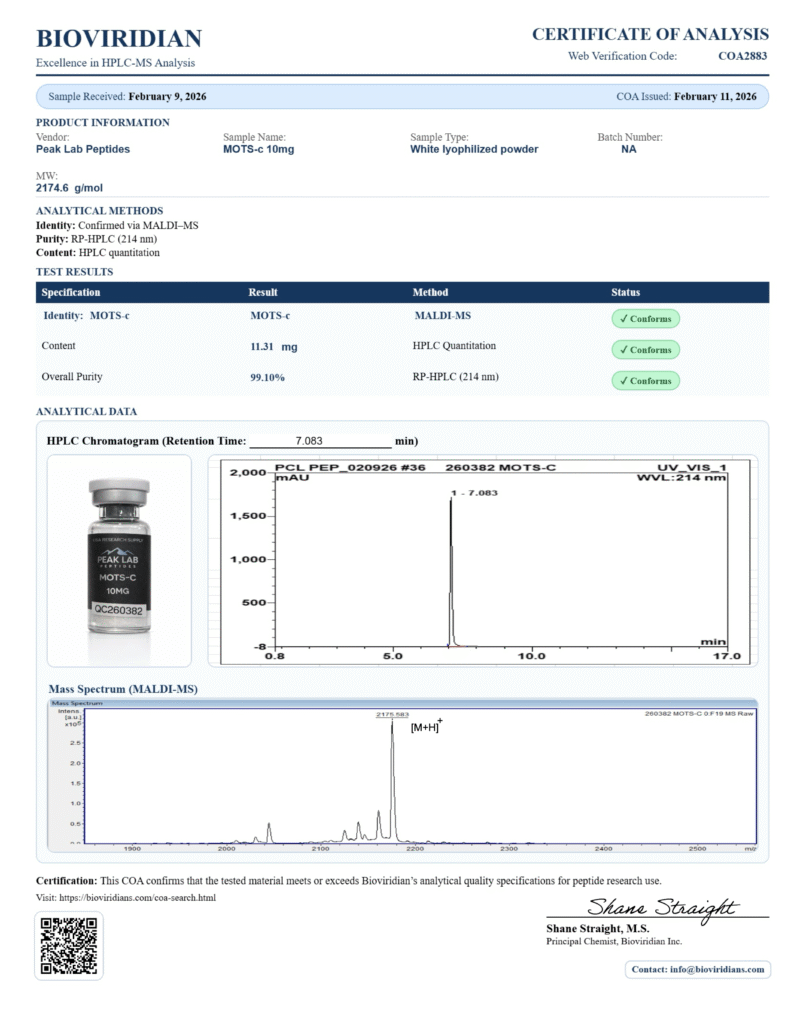
Peak Lab Peptides maintains quality-control processes and routinely performs third-party testing to support purity and identity verification. COAs are available upon request for applicable batches. Documentation may vary depending on production timelines.

We aim to make batch-level documentation available whenever possible. Our goal is to expand COA access across the full catalog as production capacity grows.

All products are for laboratory research use only and are not intended for human consumption.